
Die 1954 eingeführte Fender Stratocaster E-Gitarre wurde über die Jahrzehnte bis in die heutige Zeit hinein fast unverändert gebaut und ist schlicht die meist verkaufte E-Gitarre weltweit. Das ist ein guter Grund, sich die elektrische Ausstattung dieser zeitlosen Gitarre näher anzusehen. In diesem ersten Teil geht es um das Zentrale Bauteil der Elektrik: Den Tonabnehmer. Behandelt wird der Aufbau, die elektrischen Eigenschaften und natürlich der Klang.
Dissertation: Modellierung analoger Gitarrenverstärker mit digitaler Signalverarbeitung
Wie entwirft man einen Gitarren-Modelling-Verstärker? Die Antwort darauf findet sich in der Dissertation von Kristjan Dempwolf, die er uns dankenswerterweise zur Verfügung gestellt hat.
Schwerpunkt darin ist die Erarbeitung eines allgemeinen Ansatzes, mit dem die Modellierung beliebiger, auch nichtlinearer Schaltungen auf systematischem Wege möglich ist. Hierzu wird das Konzept des Zustandsraums aufgegriffen. Darüber hinaus ergibt sich die Notwendigkeit, ein Triodenmodell mit realistischer Nachbildung des Gitterstroms zu entwickeln.
Modellierung analoger Gitarrenverstärker mit digitaler Signalverarbeitung
Neuer Artikel über den Röhren-Modulverstärker
Im GITEC Wissens-Archiv gibt es einen neuen Artikel über den beeindruckenden Röhren-Modulverstärker, der z.B. auf dem Guitar Summit 2018 zum Test bereit stand und viel Interesse auf sich zog.
🇬🇧🇮🇪New English-language GITEC-website!🇨🇦🇺🇸🇦🇺
The English-language part of the present GITEC-website has been replaced by a separate site that can be found here:
https://www.gitec-forum-eng.de
PLEASE UPDATE YOUR BOOKMARKS!
Although some English-language content will continue to linger on the "old" site, content-management and -maintenance will only be done on the new site!
New scientific article on whether it is purposeful to „Play-in“ musical instruments
There is an ongoing controversy about whether it is purposeful to "play-in" musical instruments. In other words: do much played instruments sound different (or – preferably – even better) compared to instruments that have been played little? Dr. Gregor Weldert addresses this interesting topic in an extensive overview-article and has kindly agreed to us publishing it here on the GITEC-website:
Sound enhancement of musical instruments by "Playing them in": fact or fiction?
The translation of Chapter 10 of „Physics of the Electric Guitar“ continues
Another big chunk of the translation of the (rather extensive) Chapter 10 of "Physics of the Electric Guitar" has been completed: most everything you ever wanted to know about the first sections of a (tube) guitar amp is available: preamp, tone-controls, intermediate amp (incl. the infamous cathode-follower discussed in detail), phase-splitter/driver, associated distortion and non-linearity, noise, hum ... all there!
This makes for Chapters 10.1. - 10.4 .... and Chapter 10.5 (on the power stage) is already in the works!
Translation of Chapter 4 of „Physics of the Electric Guitar“ complete!
Wolfgang Hönlein and Andrew Graham have completed the translation of Chapter 4 of "Physics of the Electric Guitar" - it discusses magnetism, i.e. one of the foundations of our instruments. No magnet – no magnetic pickup – no electric guitar as we know it!
Special thanks got to Andrew who provided some serious help and support to Wolfgang, checking the language and proofreading the translation.
Check out the result here (scroll down until you hit chapter 4!).
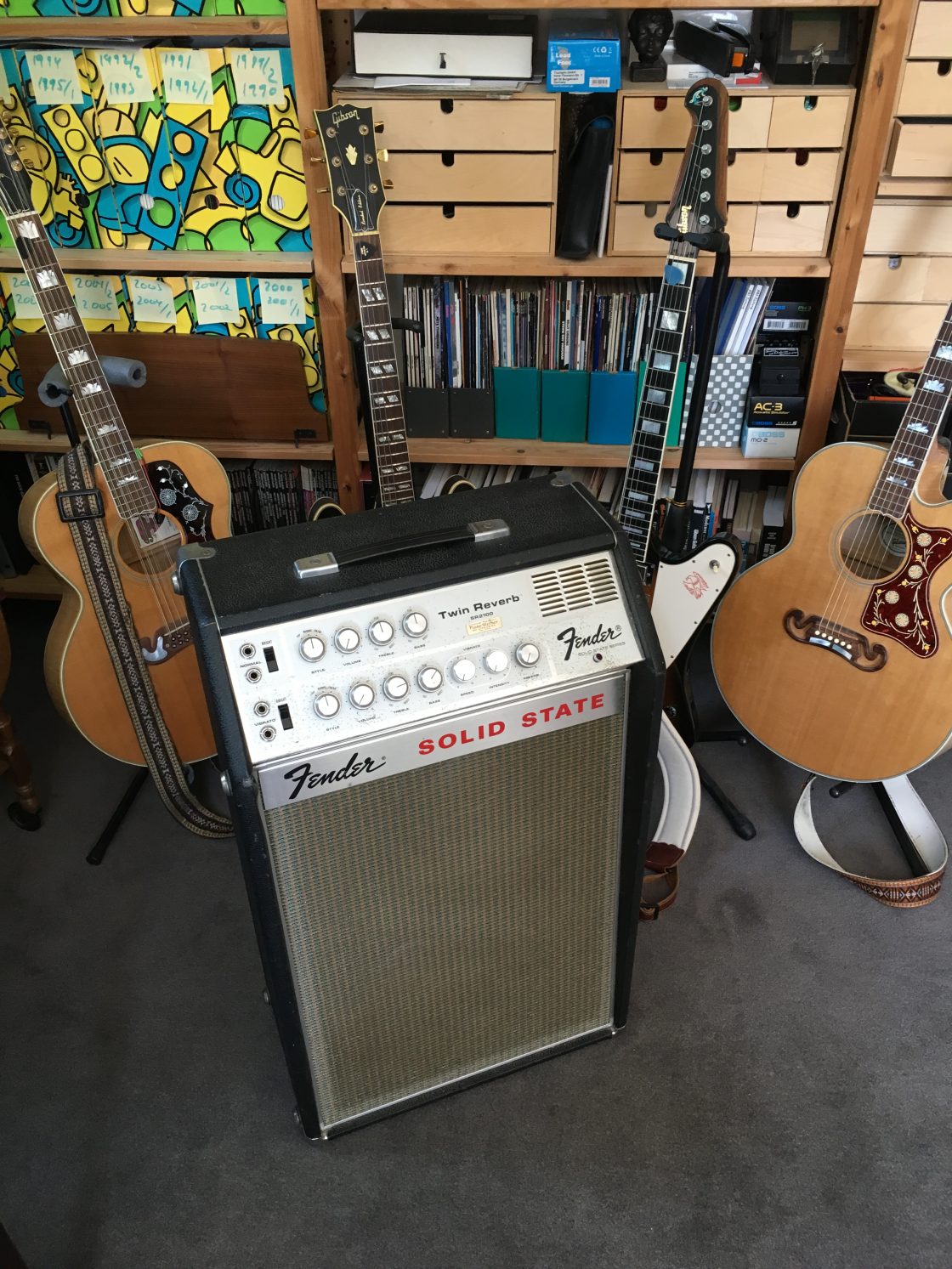
New scientific article: The 1967 Fender Solid-State Twin Reverb – the Edsel of amps?
Transistor-amps do not enjoy a particularly good reputation among guitar players. Presumably, a main contributor to this (certainly not always deserved) image was the Solid-State amplifier series unveiled by Fender in 1967. What went wrong with these amps? Is the catastrophic image they "enjoy" justified? Are they really that bad? These questions are not easy to answer – the amps are (understandably) quite rare today and very few people can actually play them and check them out.
At GITEC, we could get hold of a Solid-State Twin Reverb and investigate it inside and out - and, last not least, play it. The result is a 3-part article:
Revisiting the amp that gave "Solid-State" a bad name: the Fender Solid-State Twin Reverb:
- Part 1: Introduction, appearance, build and serviceability
Another section of PotEG translated
Our colleague Wolfgang Hoenlein has translated parts of Chapter 4 of "Physics of the Electric Guitar". It deals with magnetism and is therefore highly relevant for the magnets which power the pickups in our guitars. Check it out here (scroll down until you hit chapter 4!).
New scientific article on ALNICO magnets
We finally got around to post another scientific article in English - this one discusses the topic of ALNICO magnets in guitar pickups. Check it out! Here's a direct link for convenience....